To mark the end of the 2 year Paths to Crime cataloguing project we aim to establish a series downloadable walks. These trials will visit the places which have featured in the Quarter Session Rolls and help you imagine the crimes and criminals of the day.
To celebrate the launch of our first trail we will be undertaking a guided walk through Harrold, Odell and Sharnbrook on Sunday 30 June.
We invite you to join us for all of or just part of the walk. The complete walk is a little under 7 miles. Along the way, we will share with you some of the characters and stories which have emerged from the cataloguing of the Quarter Session Records.
We start off in Harrold at 11.30am (please meet at the main car park in Harrold Country Park). After a picnic break we will commence the second stage of our walk from Odell to Sharbrook at 1.30pm (meeting at the Odell end of the Country Park by the otter) and our finally leg, around Sharnbrook, will start at 2.30pm (from the High Street/Church Street in Sharnbrook)
We hope to see you there, but if you can't make it, don't forget the walk will be downloadable from the website for you to do at your leisure.
For more information visit http://www.bedfordshire.gov.uk/CommunityAndLiving/ArchivesAndRecordOffice/PathstoCrime/PathstoCrimeWalks/PathstoCrimeWalks.aspx#
Friday, 28 June 2013

Tuesday, 23 April 2013
Beware of those bearing good news
Repeatedly the Quarter Sessions make clear some things are timeless.
In 1864, Mark Clark, a widow of Luton received a visit from George Howard. George Howard bore exciting news for her; he said he was there on very important business. Firstly he ran through some routine questions with Mrs Clark, asking her if her husband was dead and if he had died in the asylum. Mrs Clark confirmed he had, at which point Mr Howard revealed a legacy was due to her. Howard initially stated a sum of £48 a year was due to her and £850 for each of her husbands children. Wisely, Mrs Clark sought the advice of her neighbour, and Howard explained there were 6 cottages, 160 acres of land, a mansion and furniture at Wellingborough and further property at Wootton. He went into more detail explaining the property was due to be auctioned at Bedford Bedford
Mary and her husband John, had both been born in Wootton and moved to Luton with their family. John was a gardener whilst Mary was a laundress. The 1861 census shows Mary, in Albert Street, Luton and her husband listed as being in the Alms Asylum.
The con man was captured by local police whilst drinking in the Engine public house. He confessed to his crime and was sentenced to 2 months imprisonment.
Tuesday, 9 April 2013
The Bedfordshire Reformatory
The Quarter Sessions dealt
with more than just criminal matters; they also dealt with other judicial
business. For example, 1864 included a committee report about the
Bedfordshire Reform School at Turvey. This poorly handwritten report (possibly
just a draft version) provides us with some valuable insights into the School, its
aims and how it operated.
Here’s a brief summary of its
contents:
- last report was 3 years ago
and provided for the period from the opening of the school in May 1857 to the
end of 1860.
- the total number of boys
admitted since opening is 85. 39 have
been discharged. 8 were transferred to other reformatories. 6 had died. 2 absconded. 30 were currently at the institution.
- the committee met on 3rd
Wednesday in each month and weekly visitation are made.
- 45 1/2 acres of land was
held, the land having been drained by the boys under expert tuition.
 - a bake house and dairy had
been erected.
- a bake house and dairy had
been erected.
- a medical officer visited at
least once a fortnight. The health of
the boys was satisfactory.
- instruction in reading,
writing & arithmetic was given 3 times a week and religious instruction was
given by neighbouring clergymen.
The report concluded the
institution was fulfilling its brief and that with divine blessing, best results
could confidently be hoped for!
QSR1864/1/2/3
Thursday, 4 April 2013
The boy, the wagon and the level crossing.
The safety of unmanned level crossings is frequently in the news. 1863 has thrown up a case of a young man of 12 years being charged with negligently driving 2 horses and a wagon across a level crossing on the Leicester & Hitchin Railway.
 Joseph Eckersley was a locomotive engine driver in the service of the Midland Railway Company. On 24 August he left London for Leicester with the 7.20am passenger train. The train as a government train and stopped at all stations on the Midland line between Hitchin and Leicester.
The journey was made without interruption to Sharnbrook. Irchester was the next station from Sharnbrook. It was a distance of about 6 miles and there was a rise in the line from Sharnbrook for about 3 miles and then the gradient went in the other direction. About 2 miles before Irchester station, he saw 2 horses, drawing an empty wagon, coming upon the railway at a distance of about 200 yards from the engine. The team came from the right or East of the line on which they were travelling. He could see the team was in the charge of a boy who appeared to be on the wrong side of the horses. There was private occupation crossing on the level where the wagon was going. The train was running at about 30 miles an hour and he used all his endeavours by reversing the engine and getting breaks put on to stop the train. He whistled. They were unable to stop the train before reaching the place over which the wagon was passing and the wagon was not through the gate posts when the engine came abreast of it. The hind wheels of the wagon were about half way through then gateway. However a collison was just avoided. This was tale of events was supported by his fireman, William Needham, who had been riding on the footplate of the engine. Eckersley stated that if it had been a fast train nothing would have prevented a collision.
The travelling inspector for the south district of the Midland railway, John Jeffery, ascertained that an engine chimney could be seen a mile from the spot and the engine clearly seen from the gate for half a mile. Therefore, the young accused, James Mackness, would have know a train was approaching.
Charles Gilbert also worked for the Midland Company on the railway as a labourer in a local gang. On 24 August he was working about quarter of a mile to the North of the crossing. He saw a wagon and 2 horses crossing the level before a government train came down and heard the train whistle. He witnesses the near miss. On going back to the crossing he met Gilbert Church, a lad in the employment of Mr Lathom, owner of the land on qhich the level crossing was placed. Church was driving a cart and a horse to the same crossing. He stopped Church and asked if he was the boy with the wagon and the 2 horses. Church said it had been young Jem Mackness. He saw Mackness afterwards and asked if he was the boy who had gone through the line with an empty wagon and 2 horses and Mackness replied he was. Church asked Mackness if he went to see if there was a train coming and Mackness replied “No I never thought nothing about it”.
Mackness was lucky on this occasion, both to save his own life and to be found not guilty by the court.
QSR1863/4/5/14
Joseph Eckersley was a locomotive engine driver in the service of the Midland Railway Company. On 24 August he left London for Leicester with the 7.20am passenger train. The train as a government train and stopped at all stations on the Midland line between Hitchin and Leicester.The journey was made without interruption to Sharnbrook. Irchester was the next station from Sharnbrook. It was a distance of about 6 miles and there was a rise in the line from Sharnbrook for about 3 miles and then the gradient went in the other direction. About 2 miles before Irchester station, he saw 2 horses, drawing an empty wagon, coming upon the railway at a distance of about 200 yards from the engine. The team came from the right or East of the line on which they were travelling. He could see the team was in the charge of a boy who appeared to be on the wrong side of the horses. There was private occupation crossing on the level where the wagon was going. The train was running at about 30 miles an hour and he used all his endeavours by reversing the engine and getting breaks put on to stop the train. He whistled. They were unable to stop the train before reaching the place over which the wagon was passing and the wagon was not through the gate posts when the engine came abreast of it. The hind wheels of the wagon were about half way through then gateway. However a collison was just avoided. This was tale of events was supported by his fireman, William Needham, who had been riding on the footplate of the engine. Eckersley stated that if it had been a fast train nothing would have prevented a collision.
The travelling inspector for the south district of the Midland railway, John Jeffery, ascertained that an engine chimney could be seen a mile from the spot and the engine clearly seen from the gate for half a mile. Therefore, the young accused, James Mackness, would have know a train was approaching.
Charles Gilbert also worked for the Midland Company on the railway as a labourer in a local gang. On 24 August he was working about quarter of a mile to the North of the crossing. He saw a wagon and 2 horses crossing the level before a government train came down and heard the train whistle. He witnesses the near miss. On going back to the crossing he met Gilbert Church, a lad in the employment of Mr Lathom, owner of the land on qhich the level crossing was placed. Church was driving a cart and a horse to the same crossing. He stopped Church and asked if he was the boy with the wagon and the 2 horses. Church said it had been young Jem Mackness. He saw Mackness afterwards and asked if he was the boy who had gone through the line with an empty wagon and 2 horses and Mackness replied he was. Church asked Mackness if he went to see if there was a train coming and Mackness replied “No I never thought nothing about it”.
Mackness was lucky on this occasion, both to save his own life and to be found not guilty by the court.
QSR1863/4/5/14
Monday, 11 March 2013
Progress Update
We are pleased to tell you that we have now completed the following years:
1839 through to 1862
and
1870 through to 1890
The cataloguing continues at a rapid pace. Catalogued Quarter Sessions records appear instantly on the Bedfordshire and Luton Archive and Record Service online catalogue.
1839 through to 1862
and
1870 through to 1890
The cataloguing continues at a rapid pace. Catalogued Quarter Sessions records appear instantly on the Bedfordshire and Luton Archive and Record Service online catalogue.
Wednesday, 13 February 2013
Our prisoner pin ups
 Daily Mail Online has posted a fabulous article about some of our prisoners.
http://www.dailymail.co.uk/news/article-2277501/First-criminal-mugshots-taken-Britain-revealed-150-years-featuring-thieves-thugs-conman-impersonated-vicar.html
We love the comments posted below the piece, especially about the Clark Gable look-a-like George Bennett. He seems to have set a few hearts a flutter with a number of ladies seemingly willing to ignore his missing little finger, moles, letters G.T.G.B.P. pricked in left arm, his bad front teeth and his truss!
Friday, 8 February 2013
A Ding Dong in Toddington
The obtaining of 2 pence by false pretences from a Toddington shopkeeper didn't sound the most fascinating of cases on initial inspection. However, the cheeky Toddington pair supplied us with an interesting insight into the customs of the village.
On 29 May, Sarah Smith, widow and shopkeeper woke to find an Oak bough on her doorstep. She had lived in the village for 23 years and knew it to be a local custom. Every Whitsun week it was tradition for an oak bough to be left on the doorstep of inhabitants. Later on collectors would visit for a donation. When the prisoners, George Holmes and James Lawson came to ask for money she parted with 2 pence and the men went on their way.
However, it was the 10 Bell Ringers of St George's in Toddington which staged this annual tradition. It was customary in Toddington that once a year the bell ringers would take round an oak bough to the inhabitants and afterwards collect a subscription. The bell ringers would have a supper with the money collected. The Bell Ringers met on 28 May at the Sow & Pigs public house and made arrangements that the boughs should be taken round the following morning. Thomas Smith and Samuel Brewer were appointed to go up town, where Mrs Smith lived. They left the bough at her door and called for a contribution on 30 May. However, Mrs Smith said she had already paid it. The Bell Ringers were far from happy and made a complaint that they had been robbed.
George Lawson wasn't a newcomer to crime. The always useful Bedfordshire Gaol Database describes George Lawson as quite a distinctive figure. He was blind in his right eye, had a cut mark on left cheekbone, apparently he bit his nails and the nail of little finger left hand was disfigured from a cut.
Despite the case ending up at the Quarter Sessions, George Holmes and James Lawson were let off, the case being regarded as a No True Bill. It would be interesting to know if the inhabitants of Toddington were quite so forgiving!
QSR1860/3/5/19-20
Tuesday, 22 January 2013
The anniversary of the death of Queen Victoria
Today in 1901, Queen Victoria died aged 81, at Osborne House on the Isle of Wight. By coincidence, this week, we have just begun to Catalogue the Quarter Session Rolls for 1901. As our project covers all of Queen Victoria's reign, it feels rather strange to now be referring to the King in our cataloguing process rather than to Her Majesty the Queen.
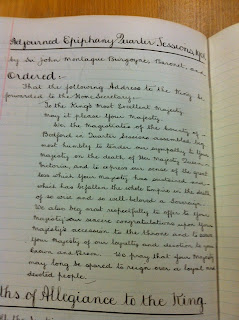
The Quarter Session Minutes book for the period contains the Address sent by the Justices of the Peace of Bedfordshire to the new king, Edward VII. The address expresses both their sympathy for the great loss which has befallen His Majesty and the whole Empire but then goes on to offer sincere congratulations to the King on his accession to the throne.
To celebrate the Diamond Jubilee of Queen Elizabeth II, the Bedfordshire and Luton Archives and Record Service document of the month, featured the visit of Queen Victoria to Woburn Abbey. The case involved a member of Queen Victoria's escort being arrested and charged with stealing a pocket watch. Click here to review the document.
QSM 49
QSR1841/4/5/11c
The Quarter Session Minutes book for the period contains the Address sent by the Justices of the Peace of Bedfordshire to the new king, Edward VII. The address expresses both their sympathy for the great loss which has befallen His Majesty and the whole Empire but then goes on to offer sincere congratulations to the King on his accession to the throne.

To celebrate the Diamond Jubilee of Queen Elizabeth II, the Bedfordshire and Luton Archives and Record Service document of the month, featured the visit of Queen Victoria to Woburn Abbey. The case involved a member of Queen Victoria's escort being arrested and charged with stealing a pocket watch. Click here to review the document.
QSM 49
QSR1841/4/5/11c
Wednesday, 9 January 2013
Stealing the boss's clothes
Francis Poole was engaged as manager of the ‘Lindslade Iron Ore Company’ at Leighton Buzzard and had been the employer of the prisoner, John Ross. However, on 9 November Ross absented himself without authority. On returning to his lodging Francis Poole was informed by his landlady that the cheeky prisoner had not only disappeared but also been to his lodging and fetched away some of his clothes. In fact he had stolen a whole outfit consisting of a black coat, a double breasted vest, a pair of black trousers, a linen shirt and a silk neck tie.
Mardling Parsons was the landlady of the Nags Head in Leighton Buzzard were Francis Poole was a lodger. She knew the prisoner to be employed by Mr Poole, so had no reason to doubt the tale he told her on 9 November. The prisoner came to her and told her a serious affair had happened and that Mr Poole had fallen into the water out of a boat. He instructed Mrs Parson that he was to take clean dry clothes back to Mr Poole and so Mrs Parson went to Mr Poole’s room and brought down a coat, vest, trousers, shirt and neck tie. She tied them in a small handkerchief of her own and gave them to the prisoner. However, soon after the prisoner had gone, a safe and dry Mr Poole returned and denied giving anyone authority to fetched away his clothes.
The prisoner went went on to pawn the set of clothes for 10 shillings. This assisted the local Police Constable, George Mardlin, in tracing the prisoner to Little Brickhill, where he found him in a public house.
John Ross was found guilty of obtaining goods by false pretences and sentenced to 3 calendar months hard labour.
Mardling Parsons was the landlady of the Nags Head in Leighton Buzzard were Francis Poole was a lodger. She knew the prisoner to be employed by Mr Poole, so had no reason to doubt the tale he told her on 9 November. The prisoner came to her and told her a serious affair had happened and that Mr Poole had fallen into the water out of a boat. He instructed Mrs Parson that he was to take clean dry clothes back to Mr Poole and so Mrs Parson went to Mr Poole’s room and brought down a coat, vest, trousers, shirt and neck tie. She tied them in a small handkerchief of her own and gave them to the prisoner. However, soon after the prisoner had gone, a safe and dry Mr Poole returned and denied giving anyone authority to fetched away his clothes.
The prisoner went went on to pawn the set of clothes for 10 shillings. This assisted the local Police Constable, George Mardlin, in tracing the prisoner to Little Brickhill, where he found him in a public house.
John Ross was found guilty of obtaining goods by false pretences and sentenced to 3 calendar months hard labour.
Tuesday, 25 December 2012
The Champkin family of Dunstable
This months festive Document of the Month on the BLARS site is an excellent read and involves the repeat offender Arthur Champkin. Arthur had a varied life and has become quite a favourite with us here in Paths to Crime. There's often a call across the office of "We've got Arthur again".
 This week I came across the case of a stolen mare and a stolen headstall (part of a bridle). The case itself wasn't one of the more interesting we've come across but the offender was ...... a young man by the name of George Champkin. A quick check on Ancestry showed he was indeed father to Arthur. It just goes to prove the depth of information we're making available online for family historians.
It's been a very productive year in Paths to Crime and we still have a wealth of information to tackle. So may we wish you all a very MERRY CHRISTMAS and a wonderful 2013.
QSR1858/2/5/3a,4
 This week I came across the case of a stolen mare and a stolen headstall (part of a bridle). The case itself wasn't one of the more interesting we've come across but the offender was ...... a young man by the name of George Champkin. A quick check on Ancestry showed he was indeed father to Arthur. It just goes to prove the depth of information we're making available online for family historians.
 It's been a very productive year in Paths to Crime and we still have a wealth of information to tackle. So may we wish you all a very MERRY CHRISTMAS and a wonderful 2013.
QSR1858/2/5/3a,4
Thursday, 6 December 2012
The Queens Shilling
 1856 saw William Burns recruited by Robert Worsley, a private in the 73rd Regiment of
Foot. Worsley asked Burns if he was willing to serve her
Majesty for 10 years and Burns replied yes. Burns was given a shilling by the recruiter as a sign of the deal. Burns remained
with Worsley in St Albans on the Thursday and Friday night but disappeared about noon on
Saturday. On the same day he disappeared John Thompson, a
sergeant in the 58th regiment, saw the prisoner at Dunstable. He had heard the prisoner wished to enlist
and went to him and asked if he was willing to serve Her Majesty in the 58th
Regiment. The prisoner replied yes. He asked the Burns if he had been in the
army before or if he had been enlisted. Burns
replied no. He enlisted him in the name of Andrew
Swaney and again he was given a shilling. However, Worsley had pursued the prisoner and that evening advised Thompson the prisoner had enlisted before. In the prisoner had no alternative but to acknowledge he had. In his defence, Burns claimed Worsley had promised to enlist him as a civilian for the term of 10
years in the 73rd Regiment and promised to have him sworn in on Friday, so he could be send away. During the time he was there, Worsley never even given him a billet for the 3 nights and had made him pay for his own lodging.
1856 saw William Burns recruited by Robert Worsley, a private in the 73rd Regiment of
Foot. Worsley asked Burns if he was willing to serve her
Majesty for 10 years and Burns replied yes. Burns was given a shilling by the recruiter as a sign of the deal. Burns remained
with Worsley in St Albans on the Thursday and Friday night but disappeared about noon on
Saturday. On the same day he disappeared John Thompson, a
sergeant in the 58th regiment, saw the prisoner at Dunstable. He had heard the prisoner wished to enlist
and went to him and asked if he was willing to serve Her Majesty in the 58th
Regiment. The prisoner replied yes. He asked the Burns if he had been in the
army before or if he had been enlisted. Burns
replied no. He enlisted him in the name of Andrew
Swaney and again he was given a shilling. However, Worsley had pursued the prisoner and that evening advised Thompson the prisoner had enlisted before. In the prisoner had no alternative but to acknowledge he had. In his defence, Burns claimed Worsley had promised to enlist him as a civilian for the term of 10
years in the 73rd Regiment and promised to have him sworn in on Friday, so he could be send away. During the time he was there, Worsley never even given him a billet for the 3 nights and had made him pay for his own lodging.
In December of the same year, the case of William Spacey came to trail. Spacey lived at Milton Bryan and was a labourer. On 11 December, PC Alfred Ing was at Woburn and saw the prisoner who he
knew well. The prisoner came to him and
said he would like to be a soldier and if he saw a militia man he would enlist
in the Bedfordshire Militia. Ing told
Spacey he was able to enlist him if he wished to join the militia. Spacey said he knew of no impediment as to
why he should not join the service and he said he was free able and willing to
serve. As a result, Ing gave Spacey a shilling and
told him to come to Woburn
the next morning. Spacey didn't show. However, Police Superintendent William Ralph Young also knew the prisoner. Young was aware Spacey had already joined the Bedfordshire Militia but had been discharged for some
defect which rendered him unfit for service, possibly a crooked toe.
Both men were found guilty, with Spacey imprisoned for 3 months and Burns for a month.
QSR1856/3/5/26
QSR1857/1/5/11
QSR1857/1/5/11
Thursday, 29 November 2012
The Prison Governor's Letter
Not all the documents we are cataloguing relate to prisoners. Epiphany 1857 contains a very sad letter written by the current governor of Bedford Prison, Robert Evans Roberts. Roberts, originally from Kent, took over as Governor in 1853 and remained there for over 30 years.
 The letter requested the court excuse his absence at the Epiphany Quarter Session of the Peace due to the recent death of his eldest daughter and the current ill heath of his second child. It appears his daughter, Elizabeth Janet, died soon after her elder sister Catherine Mary. The Quarter Session Minutes book gives mention to the outbreak of scarlet fever at the Governors house, and permission was granted by the court to whitewash the house.
 The letter requested the court excuse his absence at the Epiphany Quarter Session of the Peace due to the recent death of his eldest daughter and the current ill heath of his second child. It appears his daughter, Elizabeth Janet, died soon after her elder sister Catherine Mary. The Quarter Session Minutes book gives mention to the outbreak of scarlet fever at the Governors house, and permission was granted by the court to whitewash the house.
Only 8 years later, Roberts lost his wife Mary Ann. By the 1871 census, his remaining child, a boy named after his father, was living up in
Hull with his town clerk uncle. Robert George Roberts later followed in his fathers footsteps, becoming a prison warden in Lancashire. Robert Evans Roberts went on to remarry soon after the death of Mary Ann. He and his new wife, a rather younger lady by the name of Adelaide, stayed in Bedford and went on to have both sons and daughters.
QSR1857/1/2/1
QSM39
QSR1857/1/2/1
QSM39
Tuesday, 6 November 2012
Bonfire Night
Last November our document of the month was a deposition from a case in which a gang of boys in Houghton Regis stole straw to put on a bonfire on November 5th. In a bit of timely cataloguing I just came across a similar case in which Charles Kitchener of Luton was accused of stealing faggots (bundles of wood) from Peter Wilson in Luton. Joseph Matthews was to guard his master's faggot stack at 11pm on November 5th. A few minutes later Kitchener and two friends arrived. The friends helped Kitchener to climb the stack, from which he threw down faggots which the other two gathered. When he came down Kitchener picked up a faggot himself, only to be apprehended by Matthews and taken to the Old English Gentleman public house where he was handed over to the police. Matthews stated that nearly one hundred faggots had been taken from the stack that night. Presumably once the excitement of Bonfire Night had settled Wilson was feeling in merciful mood as the case was not prosecuted and Kitchener was discharged.
Did Luton have enough Police Constables?
...............well not according to the petition raised by inhabitants of the town in 1855. A 71 strong petition, featuring the names of business owners, solicitors and the clergy of the town petitioned the Quarter Sessions for an increase in the number of Police Constable in Luton. At the time the population of the town and parish of Luton had grown to 16,420 but was policed by just 2 Police Constables.
The petitions throws up some other interesting statistics and comments:

The petitions throws up some other interesting statistics and comments:
- on 31 December 1854 the parish and town population had increased to
16,420, with the town population of 14,000.
- the nature of the population requires more surveillance than
an agricultural population.
- the length of the parish of Luton was almost 8 miles with
the average breath of 3 to 4 miles and was almost 17,000 acres.
- the parish of Luton paid £309 for the Police Rate in 1854
and had 2 constable whilst other parishes in the Luton
division paid £250 and had the advantage of 4 constables.
- the Police Rate suggests they ought have 5 constables, considering
the inclusion of Caddington and the probable increase in low and disreputable characters
during the construction of the railway.
- the population of the county in 1841 was 107,936 for which
43 constables were considered sufficient; the rate being 1 constable per 2,500
inhabitants.
- the population of Luton now being 16,420 same rate would require 6 constables.
- inhabited houses in the Town of Luton in 1841 were only 1,139 and in December
1854 this was more than double at 2,512.
The Quarter Session minute book for this period suggests the request was successful and the Chief Constable was given the authority to appoint an additional 6 constables. The next year saw major changes in the how the policing of Bedfordshire was organised, with the introduction of revised Police Districts. In fact it's interesting to note that it wasn't until this year that it became compulsory for a county to have its own Police Force. Regardless of the changes, the issue raises its head again in later years, with the town still feeling it had insufficient Police Constables. Confirming it as a timeless issue. The image below shows, the impact of the railways is being felt.
QSR1855/4/2/3
QSM 38
QEV3
QEV3
Tuesday, 9 October 2012
I have no doubt that soot is mine!
On many occasion we have come across policeman comparing footmarks, left
at the scene of a crime, to the boots worn by the prisoners. An early document of the month from the Bedfordshire
& Luton Archives & Record Service offered a good description.
 James Addison Taylor, a poulterer and game dealer lived in
 Park Street West , Luton and had several dozen larks hanging by his door. They were tied in dozen by string through their beaks. When he went to take them in
and found 4 larks and 6 heads left in one of the dozens and 2 were gone, heads
and all. There were 8 gone
altogether. When the stolen larks were
located he took with him the heads left on the string. He was able to compare them with the bodies
found. An added detail stated that one
of the birds tongues was left in the body, drawn out of the head, and one of
the heads left at the shop had no tongue in it.
It was gory stuff to read but was compelling evidence.
However the detective work of the police frequently goes
even beyond that. For example, in the
cases of stolen crops, samples are taken from the original source and compared
with the stolen loot. A factor such as the
number of times the wheat is dressed becomes relevant. Often in the case of crops, such as potatoes,
a cultivator can recognise the goods stolen from him as he is the only grower
of that variety in the area. Sometimes it hard to believe that a chimney sweep
would recognise the soot stolen from him, but allegedly the quality and colour
did vary!
Already this current session, Epiphany QSR1855, has given
us another couple of examples. John
Green, the keeper of the White Hart at Hockcliffe, discovered 2 of his flock of
sheep missing. In a near ditch he found blood, sheepskins, heads, entrails and
feet. Police Sergeant Clough took away
the neck bones and feet of the sheep. On
discovering a number of bones in the house of James Stone, he was able to
compare the cuts and break in the bones.
This proved that the bones found in the ditch were from the same animal
as those found in Stone’s home.
 James Addison Taylor, a poulterer and game dealer lived in
QSR1850/4/5/12a-13a/a
QSR1855/1/5/8
QSR1855/1/5/19
Friday, 28 September 2012
Never underestimate a pensioner
The Quarter Session Rolls throw up criminals of all ages and the sheer gall of some is quite impressive. Take Joseph Pugh....a man of 63 years and described as a carpenter. Joseph appeared to be of no fixed abode and his crimes followed a similar pattern. In fact the Epiphany Session of 1890 has him up before the Court on 3 very similar offences.
The first instance was on 15 October 1889, when he arrived at the house of Mrs Lucy Evans of Marston Moretaine asking to lodge with her until the beginning of April. He promised to pay 3s a week and so she accepted him as her lodger. As soon as he got into the house he asked her to write him a letter to the general manager of the North Western Railway, Mr Findlay. Furthermore, he then asked her to lend him a penny for a stamp. The letter said:
Lucy Evans signed Joseph Pugh at his request.
Pugh had a full sob story to tell Mrs Evans. He told her that until recently he had been a patient in a London hospital
by train. She lent him a shilling and sixpence for the purpose. On 18 October he left the house to go to the station and saying he wouldn't be long. He never went back. He left owing 5 shillings for board and lodging and took with him the shilling and sixpence she had lent him.
Joseph Pugh goes on to commit similar offences and tell similar stories in Wootton and Ampthill. Pugh's written plea must have evoked sympathy for the ageing ailing man. (see the photo attached) The courts sentence him to just 7 days in the House of Correction.

Unsurprisingly, an old dog doesn’t learn new tricks and Mr Pugh pops up again in the next quarter. This time in Sharnbrook where he convinces his landlady he had been advised by his doctor to take in the country air! He didn’t quite gain so much sympathy from the Justices this time, as he was sentenced to a calendar months hard labour.
QSR1890/1/5/2a
QSR1890/1/5/2b
QSR1890/1/5/2c
QSR1890/2/5/1
The first instance was on 15 October 1889, when he arrived at the house of Mrs Lucy Evans of Marston Moretaine asking to lodge with her until the beginning of April. He promised to pay 3s a week and so she accepted him as her lodger. As soon as he got into the house he asked her to write him a letter to the general manager of the North Western Railway, Mr Findlay. Furthermore, he then asked her to lend him a penny for a stamp. The letter said:
“Will you please forward to the above address my month’s money as soon as you receive this letter as I have quite run out. The amount is 10 shillings.”
Lucy Evans signed Joseph Pugh at his request.
Pugh had a full sob story to tell Mrs Evans. He told her that until recently he had been a patient in a London hospital
by train. She lent him a shilling and sixpence for the purpose. On 18 October he left the house to go to the station and saying he wouldn't be long. He never went back. He left owing 5 shillings for board and lodging and took with him the shilling and sixpence she had lent him.
Joseph Pugh goes on to commit similar offences and tell similar stories in Wootton and Ampthill. Pugh's written plea must have evoked sympathy for the ageing ailing man. (see the photo attached) The courts sentence him to just 7 days in the House of Correction.

Unsurprisingly, an old dog doesn’t learn new tricks and Mr Pugh pops up again in the next quarter. This time in Sharnbrook where he convinces his landlady he had been advised by his doctor to take in the country air! He didn’t quite gain so much sympathy from the Justices this time, as he was sentenced to a calendar months hard labour.
QSR1890/1/5/2a
QSR1890/1/5/2b
QSR1890/1/5/2c
QSR1890/2/5/1
Tuesday, 18 September 2012
Inside Midsummer 1854
Having completed entering the quarter session rolls for the 1880's I've now hopped back to completing the 1850s. These years feature many more cases than the later years, and in turn take longer to catalogue.
This week I have been cataloguing the 1854 Q4 but I thought it was be a good idea to give you all a feel of a typical quarter.
Here's some statistics based in the Midsummer Session of 1854.
- Number of defendants - 33. 30 men & 3 women
- Number of cases (some defendants appear on more than one charge, others are jointly accused) - 29
- Age range of defendants - youngest is 14, the eldest 58. 14 defendants were under 20 years.
- Number found guilty - 25 of 33
- Range of Sentence - from 4 years penal servitude to 14 days imprisonment
- Types of crime - mostly theft including 7 cases of stolen fowls. Other thefts range from a stolen wooden washing tray to a silver watch guard, and from theft of a hymn book to a faggot of wood worth a half penny. We also have the killing of a sheep, a case of embezzlement, obtaining a shawl by false pretences and a sexual assault.
- Occupations of the defendants - being Bedfordshire it is unsurprising many were agricultural labourers (18 in fact). We also have lacemakers, bricklayers, shoemakers, a basketmaker, a commercial traveller, those in the plait trade, a butcher, a baker (not candlestick maker I'm afraid) and interestingly a Private Soldier in the Coldstream Guards.
We do see some seasonal themes, with the theft of food being prevalent in the Michaelmas quarter and the same family names crop up quarter after quarter ( in fact the same defendants crop up quarter after quarter). Obviously each quarter brings with it something different although we rarely have a quarter where we don't have at least one stolen fowl! It all adds to the fascination of the Quarter Sessions Rolls.
QSR1854/3
Thursday, 23 August 2012
"I'll be damned if I have not shot your daughter”
We don’t often come across gun crime in the Quarter Sessions so the shooting of 16 year old Emma Hills of Beeston instantly caught our attention.
Emma Hills retold how she had been going home along with her friend Emma Ilsley when they were overtaken by Edmund Huckle and William Jeeves on Beeston Green. Huckle was carrying a gun which he had acquired from his master. She asked if his gun was loaded and he said no. He asked her to walk by his side and she said she would not and ran forward. She heard the gun almost immediately. As soon as the gun went off she felt as if she was on fire about her neck and she fell down. Huckle picked her up and carried her home. When Emma made no response to her mother’s questions, Huckle said “Mrs Hills I’ll be damned if I have not shot your daughter”. She replied “you haven’t have you?” and he said that he had. When the blood was removed, Mrs Hills saw that her daughter had been shot on the left side of the face and down her neck and shoulders.
Fortunately the doctors, Emma’s family and Emma herself declared the incident to have been an accident and the wounds appeared relatively minor. Edmund Huckle was found not guilty of the unlawful, malicious and felonious shooting of Emma Hill and went back to his wife Sarah and his rapidly expanding family.
QSR1854/1/5/33
Emma Hills retold how she had been going home along with her friend Emma Ilsley when they were overtaken by Edmund Huckle and William Jeeves on Beeston Green. Huckle was carrying a gun which he had acquired from his master. She asked if his gun was loaded and he said no. He asked her to walk by his side and she said she would not and ran forward. She heard the gun almost immediately. As soon as the gun went off she felt as if she was on fire about her neck and she fell down. Huckle picked her up and carried her home. When Emma made no response to her mother’s questions, Huckle said “Mrs Hills I’ll be damned if I have not shot your daughter”. She replied “you haven’t have you?” and he said that he had. When the blood was removed, Mrs Hills saw that her daughter had been shot on the left side of the face and down her neck and shoulders.
Fortunately the doctors, Emma’s family and Emma herself declared the incident to have been an accident and the wounds appeared relatively minor. Edmund Huckle was found not guilty of the unlawful, malicious and felonious shooting of Emma Hill and went back to his wife Sarah and his rapidly expanding family.
QSR1854/1/5/33
Thursday, 9 August 2012
from Bicycles to Tricycles
Maybe unsurprisingly we’ve come across yet more Bedfordshire bicycle, or in this instance, tricycle crime. This time in the Epiphany session of 1889.
Luton Detective William Chamberlain was perusing the Police Gazette one evening when he read details of Jacob Josh wanted in Kings Lynn for the theft of a piano. The same man was also wanted in Huddersfield, Rugby, Portsmouth and other places for stealing tricycles. Chamberlain went round to warn the local cycle agents and ascertained that the prisoner had visited 2 other cycle agents before being allowed to borrow a tricycle from Albert Trott, a jeweller and cycle agent of Waller Street Luton.
Chamberlain hired a horse and trap and went to St Albans with Trott where they came across the tricycle in the yard of The Cock public house. They watched the prisoner go into the bar and Chamberlain followed and entered into a discussion with Trott about purchasing the machine for £2. An arrest was made, although the prisoner became violent and said he refused to be taken to prison alive. Interesting he confessed to the crime at this stage, although later pleaded not guilty to the charge. He was tried at the General Quarter Session of the Peace at Wakefield, West Riding, York and sentenced to 6 months hard labour.
Another interesting element to the case was that Josh was described in the Calendar of Prisoners (QSR1889/1/3/1) as an Engine Driver. In fact the 1881 census described him, at just 16 years, as an Engine Driver. However, records available via Ancetsry.co.uk suggest although he did once work for the railways, it was for a period of 2 months as a labourer. It would be fascinating to know if he did have a further career as a driver; it would certainly explain his travelling tricycle crimes. However in the October of 1890 Jacob Josh is again convicted of larceny, this time in Warwick. He was considered insane and confined to the County Lunatic Asylum. So possibly his interest in tricycles and trains were all part of his psychosis.
QSR1889/1/5/2
QSR1889/1/6/2
Luton Detective William Chamberlain was perusing the Police Gazette one evening when he read details of Jacob Josh wanted in Kings Lynn for the theft of a piano. The same man was also wanted in Huddersfield, Rugby, Portsmouth and other places for stealing tricycles. Chamberlain went round to warn the local cycle agents and ascertained that the prisoner had visited 2 other cycle agents before being allowed to borrow a tricycle from Albert Trott, a jeweller and cycle agent of Waller Street Luton.
Chamberlain hired a horse and trap and went to St Albans with Trott where they came across the tricycle in the yard of The Cock public house. They watched the prisoner go into the bar and Chamberlain followed and entered into a discussion with Trott about purchasing the machine for £2. An arrest was made, although the prisoner became violent and said he refused to be taken to prison alive. Interesting he confessed to the crime at this stage, although later pleaded not guilty to the charge. He was tried at the General Quarter Session of the Peace at Wakefield, West Riding, York and sentenced to 6 months hard labour.
Another interesting element to the case was that Josh was described in the Calendar of Prisoners (QSR1889/1/3/1) as an Engine Driver. In fact the 1881 census described him, at just 16 years, as an Engine Driver. However, records available via Ancetsry.co.uk suggest although he did once work for the railways, it was for a period of 2 months as a labourer. It would be fascinating to know if he did have a further career as a driver; it would certainly explain his travelling tricycle crimes. However in the October of 1890 Jacob Josh is again convicted of larceny, this time in Warwick. He was considered insane and confined to the County Lunatic Asylum. So possibly his interest in tricycles and trains were all part of his psychosis.
QSR1889/1/5/2
QSR1889/1/6/2
Tuesday, 31 July 2012
The wrong side of the law
PC George Cannon Smith found himself on the wrong side of the law in the Midsummer quarter of 1888. He was accused of stealing wood from a construction site close to his home in Pondswick Road, Luton. A neighbour, Mrs Fanny Hyde, spotted him, in full police uniform, taking wood from the new houses around daybreak one Sunday morning. The depositions suggest Mrs Hyde may have already been familiar with PC Smith. Her and her husband, Martin George had formerly run the Jolly Topper public house in Stopsley, Luton. Whilst under cross examination, it was put to Fanny that she was familiar with PC Smith from her days at the public house. In fact it was suggested he had on occasion spoken to her about her management. Mrs Hyde disputed this fact!
There was additional evidence against the officer. The foreman of the building site was able to identify a piece of wood found in the constable’s house. The foreman, Elias Hill, believed the wood bore the grease marks from the candle he had used and the nail marks from where it had been fixed to the window.
Meanwhile, PC Smith, who lived with his brother Albert Cannon Smith, said that the wood had been used by his brother. Albert elaborated describing how it was a well travelled piece of wood. It had been originally at the house when they moved in, and had then been nailed above a sitting hen. From there the piece of wood went off to the stables Albert rented, where he used it to secure his pigs, until it finally made its way back to the Smith household.
George Smith was found not guilty in this case, but it interested us to see if George remained in the force. Less than 2 years later, the 1891 census shows George and his family having moved to Wiltshire, and he is resident at the Police Station in Hungerford. However, 10 years later his family has rapidly expanded and they have been on the move again. This time he is a farm bailiff in Walton on Thames. George had come from a farming background, as his father had been a farmer of 187 acres in Redbourne, Herts whilst George was growing up. By 1911, at 52 years old and with 13 children having been born to him and his wife, he can be found as a council roadman in Hersham, Surrey. What happened in these intervening years is a mystery, but George Cannon Smith appears to have spent his later years in a very different occupation to that which he held in 1888.
 |
| The Jolly Toppers 2010 |
There was additional evidence against the officer. The foreman of the building site was able to identify a piece of wood found in the constable’s house. The foreman, Elias Hill, believed the wood bore the grease marks from the candle he had used and the nail marks from where it had been fixed to the window.
Meanwhile, PC Smith, who lived with his brother Albert Cannon Smith, said that the wood had been used by his brother. Albert elaborated describing how it was a well travelled piece of wood. It had been originally at the house when they moved in, and had then been nailed above a sitting hen. From there the piece of wood went off to the stables Albert rented, where he used it to secure his pigs, until it finally made its way back to the Smith household.
George Smith was found not guilty in this case, but it interested us to see if George remained in the force. Less than 2 years later, the 1891 census shows George and his family having moved to Wiltshire, and he is resident at the Police Station in Hungerford. However, 10 years later his family has rapidly expanded and they have been on the move again. This time he is a farm bailiff in Walton on Thames. George had come from a farming background, as his father had been a farmer of 187 acres in Redbourne, Herts whilst George was growing up. By 1911, at 52 years old and with 13 children having been born to him and his wife, he can be found as a council roadman in Hersham, Surrey. What happened in these intervening years is a mystery, but George Cannon Smith appears to have spent his later years in a very different occupation to that which he held in 1888.
QSR1888/3/5/6
Subscribe to:
Posts (Atom)