We are pleased to tell you that we have now completed the following years:
1839 through to 1862
and
1870 through to 1890
The cataloguing continues at a rapid pace. Catalogued Quarter Sessions records appear instantly on the Bedfordshire and Luton Archive and Record Service online catalogue.
Monday, 11 March 2013

Wednesday, 13 February 2013
Our prisoner pin ups
 Daily Mail Online has posted a fabulous article about some of our prisoners.
http://www.dailymail.co.uk/news/article-2277501/First-criminal-mugshots-taken-Britain-revealed-150-years-featuring-thieves-thugs-conman-impersonated-vicar.html
We love the comments posted below the piece, especially about the Clark Gable look-a-like George Bennett. He seems to have set a few hearts a flutter with a number of ladies seemingly willing to ignore his missing little finger, moles, letters G.T.G.B.P. pricked in left arm, his bad front teeth and his truss!
Friday, 8 February 2013
A Ding Dong in Toddington
The obtaining of 2 pence by false pretences from a Toddington shopkeeper didn't sound the most fascinating of cases on initial inspection. However, the cheeky Toddington pair supplied us with an interesting insight into the customs of the village.
On 29 May, Sarah Smith, widow and shopkeeper woke to find an Oak bough on her doorstep. She had lived in the village for 23 years and knew it to be a local custom. Every Whitsun week it was tradition for an oak bough to be left on the doorstep of inhabitants. Later on collectors would visit for a donation. When the prisoners, George Holmes and James Lawson came to ask for money she parted with 2 pence and the men went on their way.
However, it was the 10 Bell Ringers of St George's in Toddington which staged this annual tradition. It was customary in Toddington that once a year the bell ringers would take round an oak bough to the inhabitants and afterwards collect a subscription. The bell ringers would have a supper with the money collected. The Bell Ringers met on 28 May at the Sow & Pigs public house and made arrangements that the boughs should be taken round the following morning. Thomas Smith and Samuel Brewer were appointed to go up town, where Mrs Smith lived. They left the bough at her door and called for a contribution on 30 May. However, Mrs Smith said she had already paid it. The Bell Ringers were far from happy and made a complaint that they had been robbed.
George Lawson wasn't a newcomer to crime. The always useful Bedfordshire Gaol Database describes George Lawson as quite a distinctive figure. He was blind in his right eye, had a cut mark on left cheekbone, apparently he bit his nails and the nail of little finger left hand was disfigured from a cut.
Despite the case ending up at the Quarter Sessions, George Holmes and James Lawson were let off, the case being regarded as a No True Bill. It would be interesting to know if the inhabitants of Toddington were quite so forgiving!
QSR1860/3/5/19-20
Tuesday, 22 January 2013
The anniversary of the death of Queen Victoria
Today in 1901, Queen Victoria died aged 81, at Osborne House on the Isle of Wight. By coincidence, this week, we have just begun to Catalogue the Quarter Session Rolls for 1901. As our project covers all of Queen Victoria's reign, it feels rather strange to now be referring to the King in our cataloguing process rather than to Her Majesty the Queen.
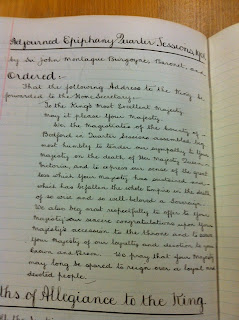
The Quarter Session Minutes book for the period contains the Address sent by the Justices of the Peace of Bedfordshire to the new king, Edward VII. The address expresses both their sympathy for the great loss which has befallen His Majesty and the whole Empire but then goes on to offer sincere congratulations to the King on his accession to the throne.
To celebrate the Diamond Jubilee of Queen Elizabeth II, the Bedfordshire and Luton Archives and Record Service document of the month, featured the visit of Queen Victoria to Woburn Abbey. The case involved a member of Queen Victoria's escort being arrested and charged with stealing a pocket watch. Click here to review the document.
QSM 49
QSR1841/4/5/11c
The Quarter Session Minutes book for the period contains the Address sent by the Justices of the Peace of Bedfordshire to the new king, Edward VII. The address expresses both their sympathy for the great loss which has befallen His Majesty and the whole Empire but then goes on to offer sincere congratulations to the King on his accession to the throne.

To celebrate the Diamond Jubilee of Queen Elizabeth II, the Bedfordshire and Luton Archives and Record Service document of the month, featured the visit of Queen Victoria to Woburn Abbey. The case involved a member of Queen Victoria's escort being arrested and charged with stealing a pocket watch. Click here to review the document.
QSM 49
QSR1841/4/5/11c
Wednesday, 9 January 2013
Stealing the boss's clothes
Francis Poole was engaged as manager of the ‘Lindslade Iron Ore Company’ at Leighton Buzzard and had been the employer of the prisoner, John Ross. However, on 9 November Ross absented himself without authority. On returning to his lodging Francis Poole was informed by his landlady that the cheeky prisoner had not only disappeared but also been to his lodging and fetched away some of his clothes. In fact he had stolen a whole outfit consisting of a black coat, a double breasted vest, a pair of black trousers, a linen shirt and a silk neck tie.
Mardling Parsons was the landlady of the Nags Head in Leighton Buzzard were Francis Poole was a lodger. She knew the prisoner to be employed by Mr Poole, so had no reason to doubt the tale he told her on 9 November. The prisoner came to her and told her a serious affair had happened and that Mr Poole had fallen into the water out of a boat. He instructed Mrs Parson that he was to take clean dry clothes back to Mr Poole and so Mrs Parson went to Mr Poole’s room and brought down a coat, vest, trousers, shirt and neck tie. She tied them in a small handkerchief of her own and gave them to the prisoner. However, soon after the prisoner had gone, a safe and dry Mr Poole returned and denied giving anyone authority to fetched away his clothes.
The prisoner went went on to pawn the set of clothes for 10 shillings. This assisted the local Police Constable, George Mardlin, in tracing the prisoner to Little Brickhill, where he found him in a public house.
John Ross was found guilty of obtaining goods by false pretences and sentenced to 3 calendar months hard labour.
Mardling Parsons was the landlady of the Nags Head in Leighton Buzzard were Francis Poole was a lodger. She knew the prisoner to be employed by Mr Poole, so had no reason to doubt the tale he told her on 9 November. The prisoner came to her and told her a serious affair had happened and that Mr Poole had fallen into the water out of a boat. He instructed Mrs Parson that he was to take clean dry clothes back to Mr Poole and so Mrs Parson went to Mr Poole’s room and brought down a coat, vest, trousers, shirt and neck tie. She tied them in a small handkerchief of her own and gave them to the prisoner. However, soon after the prisoner had gone, a safe and dry Mr Poole returned and denied giving anyone authority to fetched away his clothes.
The prisoner went went on to pawn the set of clothes for 10 shillings. This assisted the local Police Constable, George Mardlin, in tracing the prisoner to Little Brickhill, where he found him in a public house.
John Ross was found guilty of obtaining goods by false pretences and sentenced to 3 calendar months hard labour.
Tuesday, 25 December 2012
The Champkin family of Dunstable
This months festive Document of the Month on the BLARS site is an excellent read and involves the repeat offender Arthur Champkin. Arthur had a varied life and has become quite a favourite with us here in Paths to Crime. There's often a call across the office of "We've got Arthur again".
 This week I came across the case of a stolen mare and a stolen headstall (part of a bridle). The case itself wasn't one of the more interesting we've come across but the offender was ...... a young man by the name of George Champkin. A quick check on Ancestry showed he was indeed father to Arthur. It just goes to prove the depth of information we're making available online for family historians.
It's been a very productive year in Paths to Crime and we still have a wealth of information to tackle. So may we wish you all a very MERRY CHRISTMAS and a wonderful 2013.
QSR1858/2/5/3a,4
 This week I came across the case of a stolen mare and a stolen headstall (part of a bridle). The case itself wasn't one of the more interesting we've come across but the offender was ...... a young man by the name of George Champkin. A quick check on Ancestry showed he was indeed father to Arthur. It just goes to prove the depth of information we're making available online for family historians.
 It's been a very productive year in Paths to Crime and we still have a wealth of information to tackle. So may we wish you all a very MERRY CHRISTMAS and a wonderful 2013.
QSR1858/2/5/3a,4
Thursday, 6 December 2012
The Queens Shilling
 1856 saw William Burns recruited by Robert Worsley, a private in the 73rd Regiment of
Foot. Worsley asked Burns if he was willing to serve her
Majesty for 10 years and Burns replied yes. Burns was given a shilling by the recruiter as a sign of the deal. Burns remained
with Worsley in St Albans on the Thursday and Friday night but disappeared about noon on
Saturday. On the same day he disappeared John Thompson, a
sergeant in the 58th regiment, saw the prisoner at Dunstable. He had heard the prisoner wished to enlist
and went to him and asked if he was willing to serve Her Majesty in the 58th
Regiment. The prisoner replied yes. He asked the Burns if he had been in the
army before or if he had been enlisted. Burns
replied no. He enlisted him in the name of Andrew
Swaney and again he was given a shilling. However, Worsley had pursued the prisoner and that evening advised Thompson the prisoner had enlisted before. In the prisoner had no alternative but to acknowledge he had. In his defence, Burns claimed Worsley had promised to enlist him as a civilian for the term of 10
years in the 73rd Regiment and promised to have him sworn in on Friday, so he could be send away. During the time he was there, Worsley never even given him a billet for the 3 nights and had made him pay for his own lodging.
1856 saw William Burns recruited by Robert Worsley, a private in the 73rd Regiment of
Foot. Worsley asked Burns if he was willing to serve her
Majesty for 10 years and Burns replied yes. Burns was given a shilling by the recruiter as a sign of the deal. Burns remained
with Worsley in St Albans on the Thursday and Friday night but disappeared about noon on
Saturday. On the same day he disappeared John Thompson, a
sergeant in the 58th regiment, saw the prisoner at Dunstable. He had heard the prisoner wished to enlist
and went to him and asked if he was willing to serve Her Majesty in the 58th
Regiment. The prisoner replied yes. He asked the Burns if he had been in the
army before or if he had been enlisted. Burns
replied no. He enlisted him in the name of Andrew
Swaney and again he was given a shilling. However, Worsley had pursued the prisoner and that evening advised Thompson the prisoner had enlisted before. In the prisoner had no alternative but to acknowledge he had. In his defence, Burns claimed Worsley had promised to enlist him as a civilian for the term of 10
years in the 73rd Regiment and promised to have him sworn in on Friday, so he could be send away. During the time he was there, Worsley never even given him a billet for the 3 nights and had made him pay for his own lodging.
In December of the same year, the case of William Spacey came to trail. Spacey lived at Milton Bryan and was a labourer. On 11 December, PC Alfred Ing was at Woburn and saw the prisoner who he
knew well. The prisoner came to him and
said he would like to be a soldier and if he saw a militia man he would enlist
in the Bedfordshire Militia. Ing told
Spacey he was able to enlist him if he wished to join the militia. Spacey said he knew of no impediment as to
why he should not join the service and he said he was free able and willing to
serve. As a result, Ing gave Spacey a shilling and
told him to come to Woburn
the next morning. Spacey didn't show. However, Police Superintendent William Ralph Young also knew the prisoner. Young was aware Spacey had already joined the Bedfordshire Militia but had been discharged for some
defect which rendered him unfit for service, possibly a crooked toe.
Both men were found guilty, with Spacey imprisoned for 3 months and Burns for a month.
QSR1856/3/5/26
QSR1857/1/5/11
QSR1857/1/5/11
Subscribe to:
Posts (Atom)