Pages

Showing posts with label Youth Crime. Show all posts

Monday, 23 April 2012

Reformatory Ship

When boys were convicted of crimes from the 1840s onwards they were typically given a short gaol sentence followed by a period of years in a Reformatory School. At the Epiphany Sessions in 1871 Henry Tuck, a 13 year old apprentice to a shoemaker at Husborne Crawley, was convicted of stealing a coat, a hat, a scarf and a pair of shoes from his master Alfred Faulkner before absonding. He was apprended two weeks later at Huntingdon and sentenced to one month of hard labour in Gaol followed by 5 years at a Reformatory. The gaol database tells us that after his release from Bedford Gaol he was sent to the Akbar Reformatory Ship. This sounded intriguing, so I did a little research.

The informative website of the E Chambré Hardman Archive includes several pages about the Akbar. From 1855 to 1907 two school ships named Akbar were moored on the Mersey by a charitable organisation, the Liverpool Juvenile Reformatory Association. Henry Tuck would have served his time on the second Akbar, a former Royal Navy vessel which replaced its predecessor in 1862. The ship was funded by a grant from Liverpool Council, the Reformatory Association, charitable donations and parental contributions, which could be up to 5 shillings a week. Up to 200 boys could be held on the ship, where they were to receive a combination of discipline and education intended to equip them with skills for later life. The E Chambré Hardman Archive website tells us that:
Life on board the Akbar was harsh and dangerous. Food was in short supply and not very healthy. In the summer ventilation was inadequate and in the winter temperatures on board were very low. This was particularly so in 1894 when parts of the River Mersey froze for around thirteen weeks. It is no surprise that many boys fell ill and that some died. In 1893 an inspector criticised the Akbar’s health record and as a result the boys were evacuated to New Ferry Cholera Hospital on the Wirral while the ship was cleaned. Life on board any ship was by its very nature dangerous. The Akbar’s minute books record a number of accidental deaths and injuries amongst its boys.
A little research on Henry Tuck himself threw up some more interesting information. In the 1871 census a Henry Tuck, aged 13, was in the Bedford Union Workhouse. Henry had been born in Thrapston in Northamptonshire and was described as "deserted". In 1861 he had been living in Thrapston with his father Henry Tuck, a 31 year old "engine smith" born in Dunmow (Essex), his mother Maryann, aged 25 from Thrapston and a 5 year old sister Jane. The death of a Mary Ann Tuck is recorded in the Bedford registration district in 1865. It seems likely that this was Henry's mother and that some time between 1865 and 1871 the older Henry abandoned his children and disappeared. There is no trace of him on later censuses - possibly he changed his name to avoid being prosecuted for desertion. Unfortunately I was not able to find out anything about young Henry's life after he left the Akbar, as he also disappears from the censuses.

Thursday, 15 March 2012

Joyriders of 1880

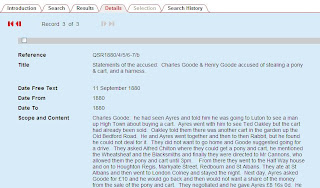
The Midsummer Session of 1880 was full of a variety of cases. However, 2 cases show some crimes are timeless. On 17 July 1880, Charles Goode went to the Wheatsheaf public house at Houghton Regis with friends Edward Stevens and Austin Bourne. After spending some time drinking together, he noticed Stevens and Bourne had gone missing. He went outside to find his pony and cart had gone. He watched Stevens and Bourne, both rather drunk, driving the cart up Chalk Hill. He spent the night looking for it, until at 3am he saw Stevens looking out of his bedroom window, and was told where to find the pony and cart.

Just 2 months later, the Charles Goode was again involved in the theft of a pony and cart. This time he was the offender, not the victim. After a few drinks with his friend Alfred Ayres he borrowed a pony and cart from Mr Cannon in Luton, as he fancied a bit of a drive. The cart was due back by 3pm but the journey took them to The Half Way House in Luton, and on to Houghton Regis, Markyate Street, Redbourn and St Albans. They ate at St Albans and then went to London Colney and stayed the night. Goode ends up selling the pony and cart in King Cross pub, so he could go on to Barnet fair. He is accompanied by his brother Henry, who the police describe as “an associate of thieves and prostitutes in Kings Cross”.

Charles Goode was found guilty of stealing the pony and cart and sentenced to 5 years penal servitude with further 3 years police supervision. The 1881 census shows him serving his time in Pentonville. It was perhaps a suitable sentence when you consider, not only did he have past form, but he had also appeared in 3 of the 4 Quarter Sessions in 1880. In the Epiphany Session he had been accused of stealing flour and at the Easter session he was found not guilty of stealing a coat from his own brother, Frederick.

You’ve got to wonder if that the last we’ll see of Charles Goode, or whether we’ll see him cropping up again in 5 years time. I’ll keep you informed.

QSR1880/1/5/15 : QSR1880/2/5/1 : QSR1880/4/5/3 : QSR1880/4/5/6-7


Extract from the Bedfordshire and Luton Archive and Records Service catalogue


Friday, 2 December 2011

Henry Wybrow & the Leighton Buzzard community 1851

The 1851 census shows the Wybrow* family of Leighton Buzzard living in Jeffs Lane. However, son Henry is missing from the family fold. Sadly poor Henry, just 14 years old, was residing in the County Goal in Bedford at the time. Although not uncommon, at the time of the 1851 census, taken on 30 March, Henry was one of only two inmates under 16 in the prison.

The QSR1851 shines more light on Henry plight. It appears that young Henry needed to raise money to play ‘pitch and hussle’ (a gambling game based on ‘chuck farthing). In order to do this, he stole a small quantity of lead off of the local Baptist chapel. He was seen on the roof. Later he sold on the lead for the sum of 2 pence halfpenny to a marine merchant.

The unusual feature of Henry case was that the local community rallied round him. A petition of 21 signatures was laid before the justices of the peace. It described their sympathy for his parents, Thomas Wybrow and Mary, and their concern at Henry, at just 14 years old, being confined in the County gaol for stealing a very small quantity of lead. In the opinion of the petitioners “he had been led into this evil through the influence of bad example”.

Henry Wybrow, did confess to the crime, and was sentenced by the Justices be imprisoned and kept at hard labour in the House of Correction for 2 weeks.

So, did young Henry deserve the faith of the residents of Leighton Buzzard? The Bedford Goal database shows that just less than year later Henry was charged with stealing wheat in his home town. However, he was given a conditional pardon and removed to The Philanthropic Society’s Farm School near Reigate in Surrey, at the time a relatively new reformatory school.
Henry’s life beyond this point is unclear, but I guess in an ideal world, we’d like to think Henry thrived on these opportunities and went on to prove himself worthy of the faith of the Leighton Buzzard residents.

*Transcribed as Whybrow
1851 census = Henry Wybrov
Source Citation: Class: HO107; Piece: 1751; Folio: 630; Page: 9; GSU roll: 87674-87675.

QSR1851/2/4/2 : QSR1851/2/5/2 : QSR1851/2/6/2 : QSR1851/2/3/4 : QSR1851/2/3/5