Pages

Monday, 23 April 2012

Drunk and Disorderly

The Easter quarter of 1883 introduced us to the character of Alfred Hirdle.  Alfred was married to Sarah and appeared in court charged with a violent assault on his wife.  She had taken a warrant out against him and in revenge he broke into their house in the early hours of the morning.  He went to his wife’s bedroom and violently hit her about the head with a stick.   He was sentenced to 5 year penal servitude.

Cases of assault appear regularly in the Quarter sessions, but we were curious to see if he was still with his wife at the time of the next census.  A little investigation saw that the couple had only been married approaching 4 years at the time of the attack.  It’s likely his wife knew the type of man she was marrying, as Alfred had been convicted (mostly of drunkenness) over 20 times before they married.  He was only 27.  He was even in trouble on the night of the 1871 census, being listed as a prisoner at Woburn police station.

We did find Sarah in the 1891, living with her mother in Ridgmont and she appears to have continued to have children in these years.  By 1901 she was still with her mother in Ridgmont with her mother, but this time she was described as a widow.   Obviously this meant we wanted to see what had become of Alfred.

A quick bit of Googling brought up the excellent MK Heritage site.  They have a section dedicated to the Fir Tree inn at Woburn Sands, where it appears Alfred Hirdle had become a frequent visitor.  The site talks of another case involving Alfred which was reported in local paper.  Once again it revolved around drunken behaviour.  The article adds an interesting footnote which solves the mystery of what became of Alfred:

 “Alfred Hirdle eventually passed away, whilst serving a sentence in Bedford Prison in 1900, aged 49. The doctors said cause of death was 'Profound Disturbance of the Brain and Apoplexy'.  Hirdle was infamous in the area, as his total of 59 convictions, mostly for being 'Drunk and Disorderly' bear testimony. Every landlord for miles around must have breathed a quiet sigh of relief!”

QSR1883/2/5/1
 
(with thanks to www.mkheritage.co.uk)

Tuesday, 3 April 2012

And your name is?

Occasionally the Quarter Sessions don’t seem completely aware of who they are dealing with. In the November 1880, 23 year old man by the name of Davis sought lodgings in the Bedfordshire village of Clifton. He claimed to be a clerk to lawyers in Oxford Street, London. He said he was down on business and would remain for about a month, or most likely until Christmas. Mrs Elizabeth Ensdersby, his new landlady, made the agreement with him that he would pay guinea a week for board and lodging. He made himself at home and moved freely around the house. After he had taken dinner he said he was off to the Woolpack Inn to see if the beer was better there than that he had been served at dinner. He did not return and she did not see him again until he was in custody. Within an hour of his leaving she went into her bedroom and missed a silver watch. She had seen it safe earlier that afternoon.

On arrest he gave his name as Herbert Clarence Percy Duroy, but refused an address and he claimed to be respectably connected and he did not wish his friends to know. He claimed to be an actor and is later described on the Calendar of Prisoners as a Comedian. He was tried in the Epiphany Quarter Session under this name, with the aliases of John Wright, Davis and William Burchell also listed. He was sentenced to 12 months hard labour in the House of Correction. However, interestingly a previous conviction was found for him under the name of Charles Edward Buckwell. In that instance he served 6 months in Cold Bath Fields, for obtaining money by false pretences.

His statement upon arrest showed he had a way with words. He said he was guilty of the charge and he wished to add that starvation was the reason he had done what he had. “Having through one fatal error blighted any prospects in my life and not being able to obtain an engagement and further having parted with all I possessed in the world for food”. He found himself “utterly penniless and destitute and therefore resorted to despicable means to save himself from starvation”.

He served his sentence under the name of Herbert Clarence Percy Duroy and appears under this name on the 1881 census (whilst in the House of Correction in Bedford). That appears to be the only record under that name. What this mans correct name was remains a mystery to us. We’d love to hear if anyone has a theory on what became of him.

QSR1881/1/5/3

Friday, 16 March 2012

Letter from Bedford Gaol

At the Epiphany Quarter Sessions of 1871 James Drage of Harrold was tried for being found at night in the dwelling house of William Bithrey at Turvey with intent to commit a felony. He was found by Bithrey's lodger Thomas Shelton on a sofa, hidden under the cover. While in Bedford Gaol waiting for his trial Drage wrote a letter which was not addressed, but was presumably intended for the Justices of the Peace who would hear his case. In the letter Drage claimed that he did not know what he was doing as he had had "a little too much drink". It was a wet afternoon on the day in question amd he had started drinking early. By the late evening he had no idea what he was doing and says "if I was a going to be hung for it I can't tell how I got in that house". He claims that if he had his wits about him he would have made his escape when discovered but he was too drunk. When Shelton and other men called in to help tried to restrain him they pulled him about which had the effect of sobering him up. Eight years earlier he had suffered from a very bad neck for 14 months which caused him to be discharged from the army. Since that time whenever he had too much to drink it went to his head. He ends by saying that when released he will join the teetotal society. The letter is beautifully written in a clear, even script, but his spelling leaves something to be desired: "it shall be a warning to me it shant be drink that shall get me into haney trubel haney more Gentlemen I jine the teatotle sursitety the very day I get my liberty".


Unfortunately for Drage the constable George Mardlin said he did not appear drunk; he had also previously been convicted at the Northampton Quarter Sessions of June 1869 for stealing more than £5 from the house of Elizabeth Copson at Wellingborough (Northants), for which he had served 12 months in the House of Correction at Northampton. This time he was sentenced to 6 months imprisonment with hard labour, to be followed by 7 years supervision by the police. 

The letter is written on a standard form issued by the Gaol to prisoners awaiting trial which includes printed instructions on the front cover:
  Persons writing to Prisoners are to TAKE NOTICE that the permission to write and receive Letters is not given to Prisoners for the purpose of hearing the news of the day, but to keep up a correspondence with their Relatives, and to address them on the subject of their trials; they will not be allowed to give or receive any improper advice or hints, or use or receive any unbecoming language.
  As all Letters sent into the Prison are read by the Governor, they ought not to be of unnecessary length.
  Visiting days are Wednesdays and Saturdays from 10 to 12 in the morning and from 2 to 4 in the afternoon; the visits must not exceed twenty minutes.
QSR1871/1/5/3/b; QSR1871/1/6/3/b

Thursday, 15 March 2012

Joyriders of 1880

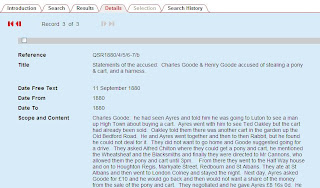
The Midsummer Session of 1880 was full of a variety of cases. However, 2 cases show some crimes are timeless. On 17 July 1880, Charles Goode went to the Wheatsheaf public house at Houghton Regis with friends Edward Stevens and Austin Bourne. After spending some time drinking together, he noticed Stevens and Bourne had gone missing. He went outside to find his pony and cart had gone. He watched Stevens and Bourne, both rather drunk, driving the cart up Chalk Hill. He spent the night looking for it, until at 3am he saw Stevens looking out of his bedroom window, and was told where to find the pony and cart.

Just 2 months later, the Charles Goode was again involved in the theft of a pony and cart. This time he was the offender, not the victim. After a few drinks with his friend Alfred Ayres he borrowed a pony and cart from Mr Cannon in Luton, as he fancied a bit of a drive. The cart was due back by 3pm but the journey took them to The Half Way House in Luton, and on to Houghton Regis, Markyate Street, Redbourn and St Albans. They ate at St Albans and then went to London Colney and stayed the night. Goode ends up selling the pony and cart in King Cross pub, so he could go on to Barnet fair. He is accompanied by his brother Henry, who the police describe as “an associate of thieves and prostitutes in Kings Cross”.

Charles Goode was found guilty of stealing the pony and cart and sentenced to 5 years penal servitude with further 3 years police supervision. The 1881 census shows him serving his time in Pentonville. It was perhaps a suitable sentence when you consider, not only did he have past form, but he had also appeared in 3 of the 4 Quarter Sessions in 1880. In the Epiphany Session he had been accused of stealing flour and at the Easter session he was found not guilty of stealing a coat from his own brother, Frederick.

You’ve got to wonder if that the last we’ll see of Charles Goode, or whether we’ll see him cropping up again in 5 years time. I’ll keep you informed.

QSR1880/1/5/15 : QSR1880/2/5/1 : QSR1880/4/5/3 : QSR1880/4/5/6-7


Extract from the Bedfordshire and Luton Archive and Records Service catalogue


Wednesday, 7 March 2012

Typical Bedfordshire Crime?

When you think about Bedfordshire occupations, straw plaiters are one of the first that spring to mind. The Epiphany Session on 1880 saw a large scale theft operation from Mr Charles Hollingsworth Hewett, a straw plait merchant. He operated from a shop in George Street, Luton and also had a bleaching and dying warehouse situated in Castle Street. Mr Hewett and his wife were never present when these dealing went on, instead having yet to arrive at the premises or having already left to take tea.

It appears, although I must say upfront most of those involved were eventually found Not Guilty, that a couple of inside men were selling off straw plait cheaply to pretty much anyone who cared to ask. A crafty system was set up between one of the shop workers, who was in charge of the inventory, and a foreman at the warehouse. The foreman would be short on the amount delivered to the shop and the shopman would cover his tracks, in return for a cut of the profits. Even after arrest, further interesting conversations took place in the yard at the police station, seeming trying to decide who was to blame.

The straw plait industry was at its peak between the 1870’s and 1880’s. To read more about the Straw Plait Industry, we would recommend the following sites.

http://www.galaxy.bedfordshire.gov.uk/webingres/luton/0.local/hat_plaiting.htm

http://www.english-heritage.org.uk/discover/people-and-places/womens-history/womenhatplaitluton/

For more information on the straw plait thefts, visit the Bedfordshire and Luton Archive and Record service catalogue - QSR1880/1/5/3 through to QSR1880/1/5/9

Monday, 5 March 2012

A quick bit of self promotion

Our very own Kathryn will be giving a talk titled "Poor Law Unions - was it all grim?"

Friday 9th March
1pm-1.45pm
at Bedfordshire & Luton Archive Service

The talk is open to members of the public, so should you be interested simply email archives@bedford.gov.uk or contact the service on 01234 228833

We look forward to seeing some of you there.

Monday, 20 February 2012

Billy the Sweep

We sometimes come across Quarter Sessions cases that read like episodes from a soap opera. Take this unfortunate incident from 1843 involving William Smith, a Leighton Buzzard chimney sweep known as Billy the Sweep. Putting together the various depositions and Smiths own statement the gist of the story appears to be as follows:

Billy the Sweep arrived home intoxicated and discovered his wife had taken out a contract with the tally man (buying goods "on tick" or hire purchase). He insisted on knowing what she had bought. When she refused to tell him how much she had paid for a shawl he carried out a threat to cut it up. Unfortunately as his wife tried to rescue the shawl her thumb got in the way of the knife Billy was using and she was badly cut. She cried "murder" and a couple of neighbours, Maria Gardner and Mary Gilbert, rushed to her aid and bound up the bleeding digit. Meanwhile a rumour reached the Royal Oak Public House that Billy the Sweep had chopped off his wife's thumb. A noisy crowd gathered outside Smith's house, laughing and teasing Billy. After a failed attempt to close the shutters and stop the crowd peering in through his window, Billy reached a pitch of exasperation in which he threatened to shoot the onlookers if they did not go away. Enraged he grabbed the nearest thing to hand. This turned out to be a potato fork - I presume this would have been similar to a modern garden fork - which he jabbed through the window into the face of an unfortunate bystander, Henry Munday.


The Royal Oak in Friday Street, Leighton Buzzard c.1925

Munday fainted, bleeding profusely. The fork had caused a minor wound to his left cheek, but a tine had penetrated deeply between his right eye and his nose. The surgeon who examined him, Philip Wynter Wagstaff, later measured the depth of the wound as greater than one inch. During that evening symptoms suggested to the surgeon that it was likely to proved fatal. Fortunately he was mistaken and by the time he gave his deposition he believed that Munday would not lose the eye and would make a full recovery. Meanwhile Billy the Sweep had been arrested and incarcerated in the parish lock-up, where he became maudlin and was heard threatening to hang himself. The constable removed his handkerchief and other items and "confined him by the leg". By this time however Billy had reverted to the furious and exasperated stage, declaring that he wished he had shot Munday and "should not care a damn if I had killed him". In the cold light of day, sobered up and facing examination by the magistrate, he was very apologetic. He was bailed to appear for trial at the Easter Quarter Sessions where he was convicted and sentenced to six months hard labour. [QSR1843/2/5/15]